
Óscar Figueroa: Columbia’s First gold in Olympic Weightlifting
Editor: Bradley Sukwanto
Óscar’s Spotlight: The Rio Olympics 2016
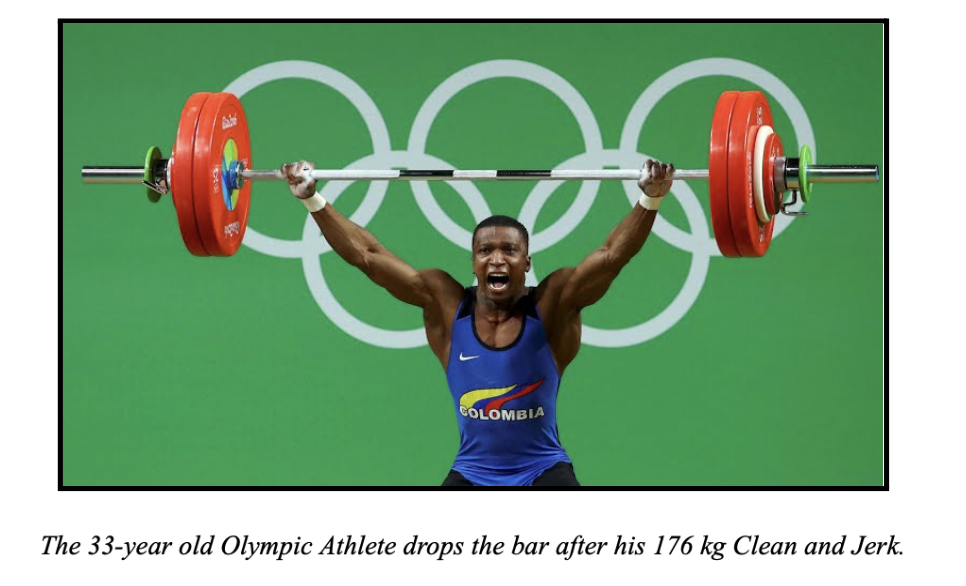
The moment had finally arrived for Óscar Albeiro Figueroa Mosquera on Monday, August 8th, 2016. Performing 142 kg snatch and a 176 kg clean and jerk, his total weight came out to 318 kg, beating his competitor by six kilos. Cheers from the fans on stage roared throughout the stage, and Óscar fell to his knees as he looked above with tears streaming down his face. In the heat of the moment the Colombian weightlifter had taken off his shoes, commenting afterwards that “It's 22 years since I started and now is the time to retire, which is why I removed my shoes.”
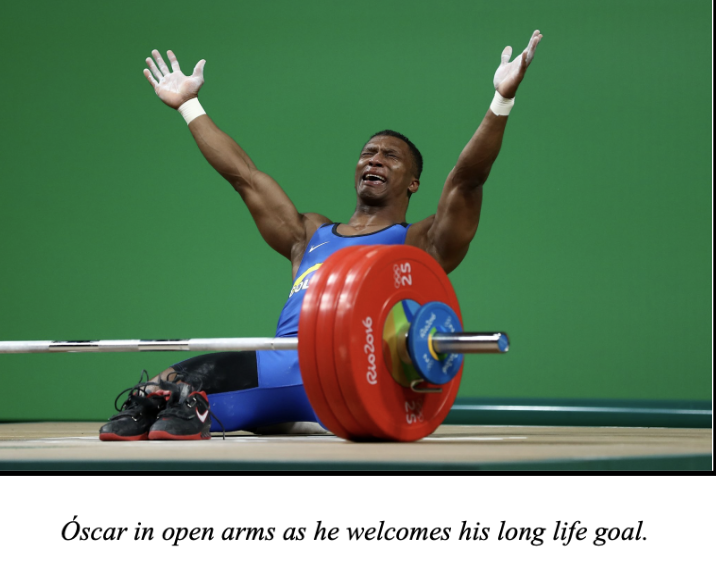
Óscar’s fans, coaches, and even competitors had been witnessing, one way or another, the story of a fight against the odds. At a young age, Óscar was pushed towards the realms of sports. He had tried his hand in swimming, track and field, Karate, and football. Yet, his exploration had led him to fall in love with the sport of Olympic Weightlifting. He was good at it, too.
Early Career:
In an interview, his early childhood coaches remarked upon his inherent capacity to approach the technique of the sport with ease, with one stating that “he had mastered it in a day.” His talent slingshotted him past local and national championships, and soon enough, he had arrived in the domain of Champions. In 2004, Óscar competed in the Olympics in Athens, Greece and placed 5th at the age of 21. He was disappointed; his objective was to be on the podium, and in the back of his mind, he desired the gold medal. The young weightlifter would, however, encounter his first obstacle, which also happened to be his first Olympic Coach.
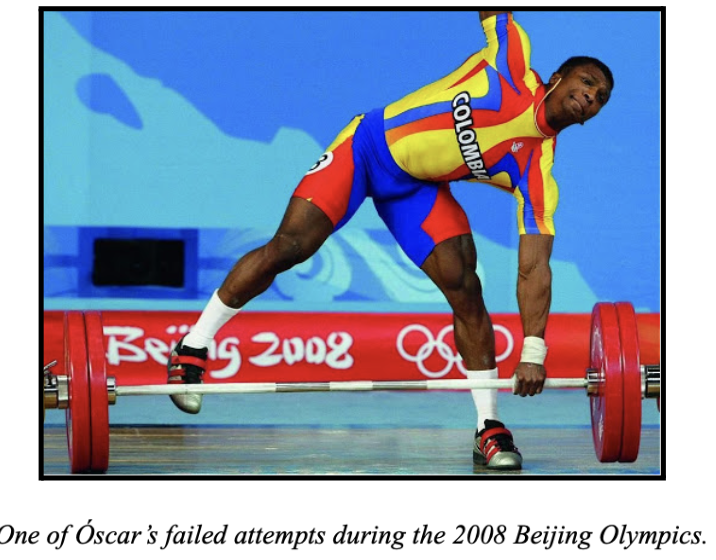
Leading up to the Beijing Olympics in 2008, Óscar’s limits were pushed to the extreme. Undergoing a training program that emphasized maximum loads for his reps, Óscar described a strong pain in his back – an omen for his coming performance.
A Mortal Blow: C6-C7 Cervical Hernia
Óscar failed all three attempts to lift the bar. Each time he attempted, his right hand commanded the arm to reflex violently backwards, as if he had been holding on to hot iron. In the aftermath, doctors revealed that the athlete was suffering from C6-C7 Cervical Hernia. For clarity, this condition can arise from trauma or through hereditary causes. Specifically, the condition is the rupture of the Annulus Fibrosus – imagine a cylinder of collagen or tissue– which surrounds the nucleus pulposus – a gel-like substance that provides the spine its fluid mobility. The nucleus pulposus in this situation may compress the spinal nerves, and, in the case of the C6 and C7 Vertebrates, cause neck and shoulder pain, impacting elbow and wrist extension, and resulting in weakness of motor functions of the arms.
On hearing this news, Óscar was devastated by this grim reality. Yet, he was determined to find a solution. With help from some doctors, he underwent surgery and commenced his training for the London Olympics in 2012. There he scored silver – for him it was not enough.
A Contentious Fight to the End: Sustained Fortitude through Injury.
Audacious still, the Colombian weightlifter desired to win gold in the games in 2016, Brazil. Óscar documents that during this period he felt a resurgence of pain – this time in the lower regions of his back. An additional MRI found that he was suffering from two lumbar herniated discs and facet joint osteoarthritis. In response, his doctor asked Óscar, “How have you been lifting weights?” underscoring both the athlete’s dedication and the intensity of his training.
This time around, the disc herniation was located in the lumbar region, which is around the hip area and below the chest. Facet joint osteoarthritis, in conjunction, implied that the athlete faced a deterioration of his facet joints, which are synovial joints that are a part of the spinal motion segment that are responsible for the motion of the spine.
Óscar, now 8 months before the games, decided to undergo surgery, and then, with a month less, began his training. He describes that during the training, “the doctor told me I was going to be in pain” since the scar was only recently healed. There were many sleepless nights. Many where he stated that he could barely move. At the end of it all, he got what he wanted.
Conclusion
Óscar revealed a strong heart in pursuing his goal of gold on the podium. His journey was filled with major psychological setbacks, challenging his mental state. The story reveals that although pain may be universal, the interpretation of it is our choice. Confronting hardship may mean accepting the inherent ugliness of a situation, but more importantly, to take to heart a warrior’s spirit in finding solutions that do not compromise our ultimate goals.
Works Cited
Fort Worth Brain & Spine. “Facet Arthritis | Neurosurgery Located in Fort Worth, Granbury, Cleburne, Weatherford and Lake Worth, TX | Fort Worth Brain & Spine Institute.” Fwbsi.com, 2018, www.fwbsi.com/content/facet-arthritis. Accessed 2 Dec. 2025.
Inoue, Nozomu, et al. “Biomechanics of the Lumbar Facet Joint.” Spine Surgery and Related Research, vol. 4, no. 1, 27 Jan. 2020, pp. 1–7, https://doi.org/10.22603/ssrr.2019-0017.
Nedresky, Daniel, et al. “Anatomy, Back, Nucleus Pulposus.” PubMed, StatPearls Publishing, 2021, www.ncbi.nlm.nih.gov/books/NBK535373/.
Olympics. “Chat with Óscar Figueroa - Colombian Weightlifting Olympic Champion.” YouTube, 27 Mar. 2017, www.youtube.com/watch?v=1yl3z-hrzvA. Accessed 2 Dec. 2025.
---. “Figueroa Gives Colombia a Golden Lift, as Thailand Enjoys a One-Two.” Olympics.com, International Olympic Committee, 8 Aug. 2016, www.olympics.com/en/news/figueroa-gives-colombia-a-golden-lift-as-thailand-enjoys-a-one-two. Accessed 2 Dec. 2025.
---. “The Incredible Weightlifter Who Wouldn’t Give up | against All Odds.” YouTube, 30 Mar. 2017, www.youtube.com/watch?v=xiTshXi7OIw. Accessed 26 Mar. 2025.
Peiris, Sudarshana. “Óscar FIGUEROA WILL RETURN to HIGH LEVEL COMPETITION.” Panam Sports, 26 Aug. 2017, www.panamsports.org/en/news-sport/Óscar-figueroa-will-return-to-high-level-competition/. Accessed 2 Dec. 2025.
Samir Sharrak, and Yasir Al Khalili. “Cervical Disc Herniation.” Nih.gov, StatPearls Publishing, 2 Sept. 2019, www.ncbi.nlm.nih.gov/books/NBK546618/.