
The Compound Fracture
Editor: Bradley Sukwanto
Introduction
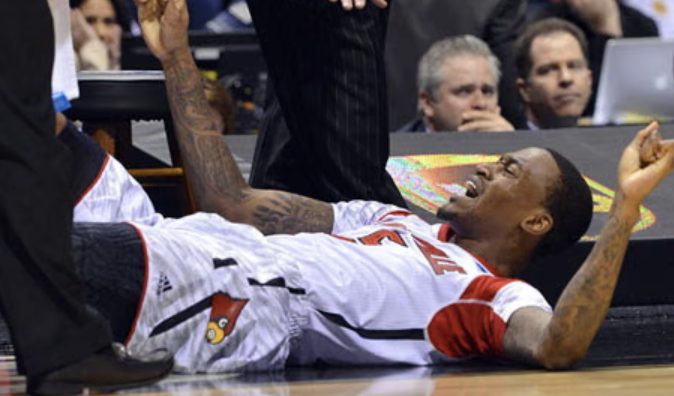
On March 31st, 2013, the Louisville Cardinals were facing the Duke Blue Devils when guard Kevin Ware for the Cardinals went up to contest a three-point shot on the right wing. Everything was normal: the shot was normal, the contest was normal, except the landing was tragic. As soon as Ware hit the ground, the injury was instantaneous. As his right leg flopped uncontrollably in front of all to see, both players and coaches were stunned and panicked.
Kevin Ware moments following his compound fracture in his right tibia.
*The image of the injury is too gruesome to be shown
Injury
Now, what exactly was Ware’s injury? Well, Ware suffered one of the worst injuries imaginable: a compound (or open) fracture. A compound fracture is when a broken bone pierces through the skin, making it visible from the outside and susceptible to infection and tissue damage. Specifically for Ware, it was his tibia bone, the strongest bone in the lower leg, that snapped upon impact with the ground.
In compound fractures, it isn't only the bone that is affected. Additionally, there is damage to the surrounding muscles, blood vessels, and the skin due to a bone breaking the surface. What makes compound fractures especially serious is the following:
Bone exposure: The broken bone pushes through the skin, effectively creating an open wound
High infection risk: Because the wound is open, it is easily susceptible to bacteria which can enter the body easily through the opening
Soft tissue damage: Muscles, blood vessels, and nerves all around the bone are damaged in injury
Treatment for Compound Fractures
The treatment for compound fractures requires both immediate and long-term action. Right after the injury, the first action that should be taken is to prevent infection and stabilize the patient, while preventing them from going into shock. In emergency care:
Ensure the wound is covered in a sterile dressing
Control the bleeding
Immobilize the affected limb by using a splint
Give the patient intravenous antibiotics to prevent infection
Following the treatment that occurs right after the injury, there must be surgery, particularly by utilizing metal rods (intramedullary rods), plates, and screws, or external fixation.
Intramedullary rods are inserted into the follow end of a long bone and then run through the middle of the bone with screws to secure it at the top and bottom. It functions to keep the bone stabilized and aligned.
X-ray image of intramedullary rods
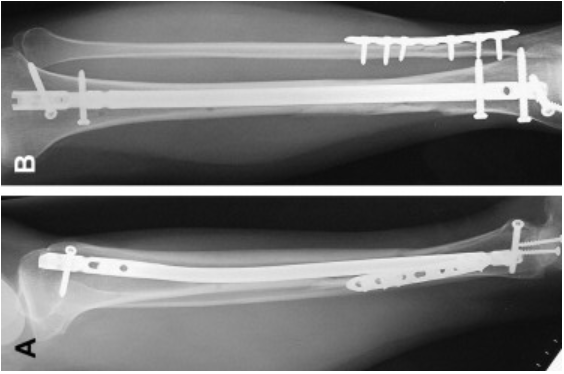
Plates and screws are a technique where they are attached to the outside of the bone to hold broken pieces together.
External fixation is when the bone is stabilized by using a frame outside the body. This is used for severe compound fractures and is only temporary until a permanent fix, such as a rod or plate, can be done.
Return?
The return of athletes suffering compound fractures is quite long compared to almost any other injury imaginable in sports. As stated earlier, there is just so much damage to multiple parts of the human body, which makes recovery such a lengthy process. Additionally, the severity of the compound fracture, location, type of surgery, and rehabilitation quality all play a role in how soon, if ever, an athlete can return. Below is an estimated timeline…
Bone healing | 3-6 months
Rehabilitation and strength training | 3-6 more months
Return to practice | 6-9 months
Return to full competition | 9-12+ months
ConclusionEven with rare injuries such as compound fractures existing and affecting athletes from time to time in the most gruesome manner, the fact that some of these players return to play is a strong statement to the advancements of medicine and rehabilitation that have evolved in the contemporary world.
Works Cited
Guardian News and Media. (2013, April 1). Louisville guard Kevin Ware resting after surgery on Broken Leg. The Guardian. https://www.theguardian.com/sport/2013/apr/01/louisville-kevin-ware-surgery-broken-leg
Intramedullary rod - an overview | sciencedirect topics. ScienceDirect. (n.d.). https://www.sciencedirect.com/topics/medicine-and-dentistry/intramedullary-rod
Compound fracture: What is it, types, symptoms & treatment. Cleveland Clinic. (2025, September 26). https://my.clevelandclinic.org/health/diseases/21843-compound-fracture
Ricci, W. (2005). Compound fracture: Open fracture. Hospital for Special Surgery. https://www.hss.edu/health-library/conditions-and-treatments/list/compound-fracture