
The Bad Case of Dead Butt Syndrome
Editor: Bradley Sukwanto
“Dead Butt syndrome” is a loose term referring to gluteal amnesia and gluteus medius tendinosis. Regardless of nomenclature, the consensus among the literature defines the syndrome as a state where the gluteal muscles are in a weakened or inhibited state that prevents the full utilization of the muscles.
The Big Three and the Antagonist:
The glutes are often split into three parts: gluteus maximus, gluteus medius, and gluteus minimus. The gluteus maximus is the chief muscle in powerful movements such as running. The gluteal medius and gluteal minimus are muscles that are often cited as being the stabilizers during locomotion, which includes both vigorous exercise and simply walking.
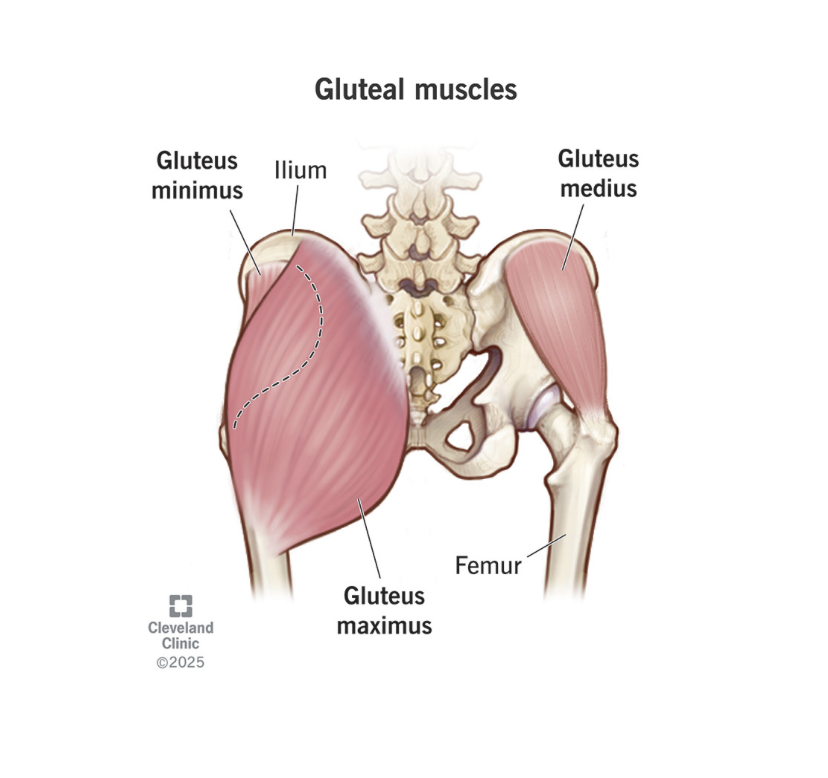
These muscles alone are not the sole reasons why humanity can enjoy the rigors and benefits of physical activity. Other muscles and tendons in the knee, lower back, and, more broadly, the leg play an integrated role in lower-body movement, known as gait.
Additionally, behind this system of muscles is the nervous system. The nervous system is responsible for coordinating the interactions of the aforementioned muscles through electrical signals along cells known as neurons.
Despite the amassed effort that exists between the different muscles and nerves, the human body is always looking for the path that is most energy efficient, or rather, the path of least resistance. This conceptual outlook of the body is used to explain that because of the sedentary lifestyle that has become more commonplace in the twenty-first century, the body is learning to adapt to prolonged hours in the sitting position.
Namely, this behavior results in a neuromuscular adaptation where other muscles, such as the lower back and the hamstrings, take a greater role in locomotion as opposed to the glutes. The added stress to other muscle groups has been indicated in poorer physical performance and an increased chance of injury.
Checks and Balances:
One of the prominent ways to identify whether you may have weak or unresponsive glutes is the glute bridge. Signs of weakened glutes could include difficult glute activation during a movement or the feeling of the hamstring being responsible for more work during a particular movement.
The following are exercises that are cited as an effective means of building strength. If any of them cause major pain, then it is advised to avoid performing the movement:
Glute Brides: Lie down with your knees bent. Place both feet at an arm's distance from your shoulders, and push from the ground with your feet. Do not overextend the movement by pushing the core outwards. The exercise can be performed isometrically or with repetitions. The latter is great for beginning to learn the feeling of activated glutes, whereas repetitions act as a means to learn the transitions between activation and relaxation.
Side Planks: Lie on your elbow and the side of your leg. Push yourself from the ground, stabilizing yourself with your core and hips. Ensure that the spine is in line with the hip. Hold initially for 10-20 seconds and build up over time. Switch sides between repetitions.
Clamshell with exercise band: If you happen to have a band, this exercise is great. Wrap the band above your knees, and lie down on your side. Extend the leg that is above the bottom slowly, ensuring that the bottom leg is kept on the floor.
If the condition is chronic, seeking out professional assistance is recommended.
References
BannerHealth. (2024, December 16). Treatment Options for Dead Butt Syndrome | Banner Health. Retrieved March 12, 2026, from Bannerhealth.com website: https://www.bannerhealth.com/healthcareblog/better-me/treatment-options-for-dead-butt-syndrome
Buckthorpe, M., Stride, M., & Villa, F. D. (2019). ASSESSING AND TREATING GLUTEUS MAXIMUS WEAKNESS – A CLINICAL COMMENTARY. International Journal of Sports Physical Therapy, 14(4), 655. Retrieved from https://pmc.ncbi.nlm.nih.gov/articles/PMC6670060/#B10
Clinic, C. (2025, March 26). Gluteal Muscles (Glutes): What They Are, Anatomy & Function. Retrieved from Cleveland Clinic website: https://my.clevelandclinic.org/health/body/gluteal-muscles-glutes
Joy, K. (2017, July 7). Are You at Risk for Dead Butt Syndrome? Retrieved from Michiganmedicine.org website: https://www.michiganmedicine.org/health-lab/are-you-risk-dead-butt-syndrome
Murphy, J. (2024, September 4). What Is Dead Butt Syndrome? The New York Times. Retrieved from https://www.nytimes.com/2024/09/04/well/move/dead-butt-syndrome-gluteal-amnesia.html
Roland, J. (2019, July 23). All About Gluteal Amnesia (“Dead Butt Syndrome”). Retrieved March 12, 2026, from Healthline website: https://www.healthline.com/health/dead-butt-syndrome