
Saddle Height: A Factor for Optimal Conditions for a Comfortable and Robust Ride
For athletes entering into the world of cycling for recreation, cross-training, or to pick up a sport, it is crucial to tailor the specification of a bike to one’s own body– otherwise known as bike fitting. The purpose of this article is to provide an overview of the popular methods that can be used to estimate optimal saddle height, along with describing its relationship with risk of injury and performance optimization.
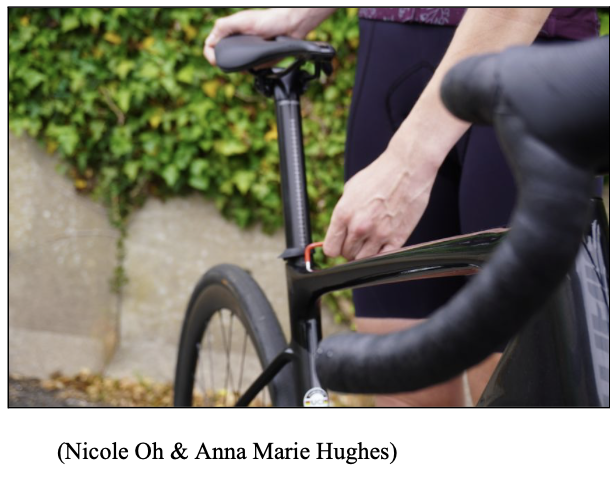
Saddle Height as a Factor for Performance and Risk of Injury:
Current literature explains that excessively low or high seat height impacts the mechanical movements of the knee, namely its range of motion. The common consensus is that the knee flexion angle should be around 25 to 35 degrees. When outside of this interval, excessive strain weighs on muscle groups and tendons near the hamstring, contributing to anterior and posterior knee pain. Optimal saddle height, in an umbrella review, has been identified as a main antagonist for injuries concerning, but not limited to, the patellofemoral and tibiofemoral joints, anterior cruciate ligament, iliotibial band, and lumbar spine. Pain near the knee and hamstrings is documented as an indicator of excessive stress, with later symptoms concerning lower back and neck pain. Incorrect bike fitting that is prolonged can result in neuropathy, reproductive harm, and excessive inflammation, which may manifest as trochanteric bursitis, iliopsoas tendinitis, and patellofemoral pain syndrome. Saddle height plays a factor in producing maximum anaerobic power output during a ride, which some studies have extrapolated as a marker of overall performance. Other studies have linked saddle height with oxygen economy, with minimum oxygen consumption being improved with the optimal height.
Methods for Acquiring Optimal Saddle Height:
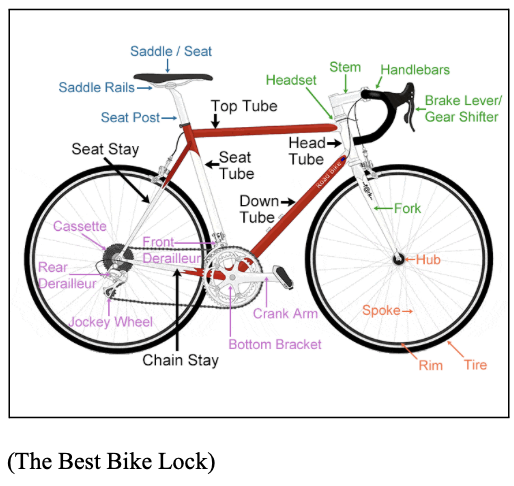
Before describing the methods and formulas below, here are a couple of terms to know. The bottom bracket refers to the part that holds the crank arm to the body of the frame (see image below). The seat tube runs from the seat to the crank arm, and the lowest point of the pedal stroke is defined when the pedal is pressed down at the six o’clock position of the seat tube.
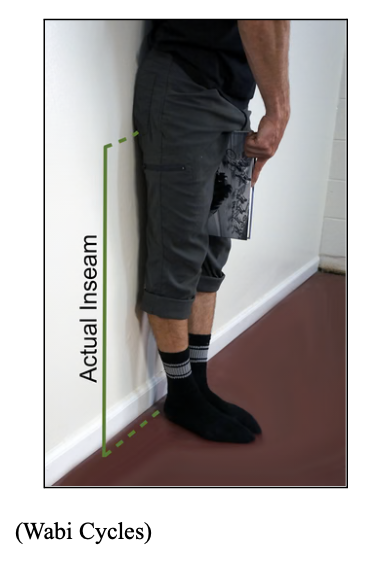
Another important term is inseam length. To acquire the measurement of the inseam, perform the following:
1. Acquire a book (hardcover preferably), and locate a flat floor and a wall. Perform the following with socks or barefoot only.
2. Stand straight along the wall and place the book between the legs with the feet shoulder-width apart. Ensure that the feet are touching the wall and that the legs are straight. Finally, with one hand, pull up the book firmly into the groin. Make sure that the book is evenly touching the wall.
3. Measure the top of the spine of the book to the bottom of the floor.
4. Perform the three steps above three times, repeating any measurements that happened to be outliers. Calculate the average inseam length.
Hamley and Thomas Formula
This method multiplies the inseam length by 1.09 and subtracts it from the crank length. This is done because the formula measures the saddle height from the lowest point of the pedal stroke to the top of the seat height (1.09 * IL – crank length = saddle height).
LeMond Formula
Named after Greg Lemond, the method considers saddle height from the bottom bracket to the top of the saddle. Seat height is found with IL being multiplied by 0.883 (0.883 * IL = saddle height)
Holmes Method:
The Holmes method has been regarded as a potentially more accurate means of acquiring optimal seat height. It considers knee flexion angle at the lowest point of the pedal stroke, standardizing the optimal range for riders to be within 25 to 35 degrees. To perform this, however, more than one individual may be needed since it requires either a video to be taken while cycling or the use of a goniometer.
Heel Method:
One of the more convenient means of establishing an estimated optimal saddle height is to perform the following:
On your bike, place the heel on the pedal and position the crank at 6:00 in line with the seat tube.
The knee should be straightened out completely. If the knee is bent, then it means the seat height is currently short, and if the hips are swaying instead of being even during the stroke, it means the seat is excessively high.
Finally, place the front of the foot on the pedal. The leg should have a slight bend at the pedal's lowest position and should be comfortable.
Final thoughts
Cycling should be a tough ride, but it does not have to be excessively painful. With the methods mentioned above, it is important to go through the trial and error of finding the right saddle height. If the hip is rocking with each stroke or if the foot is inclining forwards in order to complete the stroke, then it likely means the seat is exceedingly high. Likewise, if there is a struggle to produce high power output or if there is a consistent feeling of the body moving back towards the seat, then it may indicate an overly short seat height.
Finally, bike fitting is not limited to saddle height, though it does play a major role. When deciding to buy a bike, it is important to consult with an expert so that they can provide the correct frame and hopefully provide recommendations as to where to properly tailor the bike.
References
Andrea Champredonde. 2016. How to Measure Your Inseam: The First Step Towards a Right-Sized Bike. September 2016. https://www.welovecycling.com/wide/2021/09/16/how-to-measure-your-inseam-the-first-step-towards-a-right-sized-bike/.
Bicycles East. 2020. How to Measure Your Inseam for a Bicycle. 27 April 2020 https://www.youtube.com/watch?v=wGUTPmnrRJM.
Maxmiliano Martínez, Miguel A. Pérez. 2025. Biomechanical Analysis of Knee Flexion and Saddle Height Adjustment on Knee Pain in Amateur Cyclists. September, 2025. https://doi.org/10.7752/jpes.2025.09217.
Morris B. Mellion. 2012. Common Cycling Injuries. October. https://link.springer.com/article/10.2165/00007256-199111010-00004.
Nicole Oh. 2026. The Physio and Bike Fitter’s Guide to Setting Your Saddle Height. May 2026.
https://www.cyclingweekly.com/fitness/bike-fit/set-saddle-height-how-to-25379.
Pedro Castro Vigário, Pedro Nunes Martins, António Rodrigues Sampaio, and Ricardo Maia Ferreira. 2024. Effects of Saddle Position on Cycling: An Umbrella Review. no. Exercise Physiology and Biochemistry: 2nd Edition (December). https://www.mdpi.com/2673-9488/4/4/32.
Rodrigo Rico Bini, James L. Croft, and Patria A. Hume. 2012. Effects of Bicycle Saddle Height on Knee Injury Risk and Cycling Performance. October, 2012. https://link.springer.com/article/10.2165/11588740-000000000-00000.
Rodrigo Rico Bini and Patria A Hume. 2014. Effects of Saddle Height on Knee Forces of Recreational Cyclists with and without Knee Pain : Original Research Article. June, 2014. https://journals.co.za/doi/abs/10.10520/EJC154973.
The Best Bike Lock. 2025. Parts of a Bike Diagram: Bicycle Anatomy for Beginners. March. https://thebestbikelock.com/parts-of-a-bike/.
WILL W. PEVELER, JOSH D. POUNDERS, and PHILLIP A. BISHOP. 2007. EFFECTS OF SADDLE HEIGHT ON ANAEROBIC POWER PRODUCTION IN CYCLING. November, 2007. https://www.ovid.com/jnls/nsca-jscr/abstract/00124278-200711000-00007~effects-of-saddle-height-on-anaerobic-power-production-in?redirectionsource=fulltextview.
Willard W Peveler and James M Green. 2011. Effects of Saddle Height on Economy and Anaerobic Power in Well-Trained Cyclists. March, 2011. https://www.ovid.com/jnls/nsca-jscr/pdf/10.1519/jsc.0b013e3181d09e60~effects-of-saddle-height-on-economy-and-anaerobic-power-in